
Rising commodity prices are set to hurt margins of India Inc in the on-going fourth quarter of FY 11, even though revenues are seen higher than the previous year, ratings agency Crisil said on Monday.
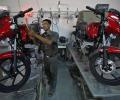
Bajaj Auto, India's leading two-wheeler (2W) and three-wheeler (3W) maker, is scaling up its wholly owned finance subsidiary, Bajaj Auto Credit Ltd (BACL), with an investment of more than Rs 3,000 crore planned over the next two financial years, company's managing director Rajiv Bajaj said. BACL has already started commercial operations, Bajaj recently said on the sidelines of the group's CSR identity event. According to rating agency CRISIL, BACL's operations began on January 1 after receiving its licence from the Reserve Bank of India (RBI) in August last year.

'The levy proposed to be charged on air tickets for regional connectivity fund would marginally increase cost.'

Amid low growth elsewhere, gross value added (GVA) growth in agriculture and allied activities recovered during the second quarter of the current financial year (Q2FY25) to 3.5 per cent year-on-year (Y-o-Y) due to strong monsoon. Experts feel that the rains have laid the foundation of an even better GVA performance in subsequent quarters. GVA growth in the first quarter of FY25 was 2.0 per cent.

According to Crisil, home prices had fallen by 18 to 20 per cent in March 2009, from the highs seen in the first half of 2008, due to the global slowdown, fears of job security and slowing growth in the domestic economy, the report said. 'However, despite this drop in capital values, home buyers have adopted a 'wait and watch' policy,' the report added.
Investment in such companies exposes an investor to severe price volatility in case a promoter is not able to meet payments.
Revenue and profit contractions to continue till investment cycle does not revive.
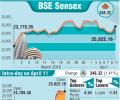
Investors are keenly awaiting the announcement of the macroeconomic data.
A sharp rise in construction and funding costs will increase costs for builders and prevent a reduction in home prices.
Revenues of Indian companies, excluding those engaged in banking and oil, are expected to grow marginally at 5-6 per cent in the first quarter of this fiscal.

When the world was upended by the Covid-19 pandemic, metals got its shine back. In the last two years, infrastructure spending by major economies spurred demand, energy transition and intermittent supply disruptions fuelled a scorching rally in metals after a downturn during the first Covid wave. Now, Russia's war on Ukraine is ensuring that elevated prices stay the course.

The domestic currency will appreciate to touch the 50 level by next March provided certain measures are taken by the government urgently, the rating agency's research wing said in a note.
CRISIL predicts no more than 6.5 per cent yearly from now till FY19, and only with a stable and decisive government; predicts problems in job generation, poverty and demand.

Dr Nagesh Kumar, one of the three new MPC members, wanted the MPC to reduce the repo rate by 25 basis points to 6.25%.
Credit rating agency Crisil on Wednesday said depreciation in the rupee will shave off up to Rs 4,000 crore (Rs 40 billion) from the profits of Nifty companies in the December quarter.

Foreign investment in multi-brand retail could help ease the problem of high food prices, an issue on which the government is fighting a major political battle, research firm Crisil said.

Initial projections, at least, suggest that things are not looking good enough for India Inc, as margins are expected to soften further.

Crisil Research expects retail inflation to rise 60 basis points to 4 per cent this fiscal from 3.4 per cent in 2018-19.

India always faces a Hobson's choice as far as feeding coal-fired generators goes - even if the government is reluctant to admit it. The country cannot do without shipping in the world's most polluting fuel from overseas. And it will continue to do so unless it decides to reduce demand by forcing citizens, farmers and businesses to live without electricity for part of the day, or use diesel generators to fire facilities.

The affordable housing segment may be seeing an uptick which is a good sign of consumption momentum. This is the biggest-ticket purchase for middle income and lower income families. The current activity is at least partly driven by a pause in interest rate hikes.
The higher outlay for the Commonwealth Games would aid the hotel sector in faster execution of the projects in the NCR region.

IIM-A announced a tie-up with three corporate houses -- CRISIL, ATS Infra and SAP -- for research in financial markets, infrastructure and entrepreneurship.
Equities registered their sharpest ever and most rapid decline in 2008, reflecting global market conditions and concerns over a slowing domestic economy.
The number of base stations installed by Indian wireless operators is inadequate to provide high-quality services to the growing number of mobile subscribers, said a research.

'With tuition fees for international students rising, education loans have become critical for bridging the gap between savings, scholarship, and full cost.'

Home sales in the top 10 cities - Ahmedabad, Bengaluru, Chandigarh, Chennai, Hyderabad, Kochi, Kolkata, Mumbai Metropolitan Region (MMR), National Capital Region (NCR) and Pune - have declined at a compound annual growth rate of 8% since 2011.
According to Crisil Research, the average room rates in cities like Chennai, Hyderabad and Bangalore are likely to fall 5-10 per cent in the next few months. Industry experts said the occupancy rates could fall from 75-80 per cent now to 65-70 per cent soon.

'The Budget needs to focus more on social welfare schemes.'
The present home loan non-performing asset figures of banks understate the extent of delinquency in the sector as loans given in the last three years

On the fiscal deficit front, its president for research flagged concerns over the revenue collections from the taxation front and also about the government not being able to achieve its Rs 40,000-crore (Rs 400-billion) divestment target.

Petrol and diesel prices were hiked by 80 paise a litre each on Saturday, the fourth increase in five days as oil firms passed on to consumers the spike in cost of raw material. Petrol in Delhi will now cost Rs 98.61 per litre as against Rs 97.81 previously while diesel rates have gone up from Rs 89.07 per litre to Rs 89.87, according to a price notification of state fuel retailers. All the four increases since the ending of a four-and-half-month long hiatus in rate revision on March 22, have been of 80 paise a litre.

The government on Tuesday proposed reducing the long-term capital gains tax on immovable properties to 12.5 per cent from 20 per cent, but removed the indexation benefits to adjust for inflation, a move experts termed as "negative" for sellers.

Concerned over the fallout of the Red Sea crisis and severe shortage of containers against the backdrop of a steep decline in merchandise exports in August, the Union government is pulling out all the stops to find a solution. To begin with, the government has devised a strategy aimed at boosting container supply and supporting exporters.

The cost of a representative home-cooked vegetarian thali has witnessed a 5 per cent on-year increase in January, while that of the non-veg thali declined 13 per cent, a report said on Wednesday. According to Crisil Market Intelligence and Analytics (MI&A) Research 'Rice Roti Rate' estimates, the rise in prices of ingredients like pulses, rice, onion and tomato made home-cooked veg thali costlier in January, while decline in poultry rates helped in the fall in non-veg thali rates.

Petrol price on Monday was hiked by 30 paise a litre and diesel by 35 paise, taking the total increase in rates in the last one week to Rs 4-4.10 per litre. Petrol in Delhi will now cost Rs 99.41 per litre as against Rs 99.11 previously while diesel rates have gone up from Rs 90.42 per litre to Rs 90.77, according to a price notification of state fuel retailers. Rates have been increased across the country and vary from state to state depending upon the incidence of local taxation.

Size matters on the road. Small is not dominating India's car market any more. The share of cars priced up to Rs 5 lakh in the passenger vehicle market has fallen to 10.5 per cent in the first 11 months of 2021-22, compared with 26 per cent in 2018-19 (FY19), the lowest in four years, according to data from industry sources. Even the share of those in the price range between Rs 5 lakh and Rs 7.5 lakh has dropped to 32.4 per cent in the same period, from 34.9 per cent.
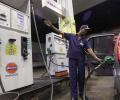
Petrol price on Sunday was hiked by 50 paise a litre and diesel by 55 paise, taking the total increase in rates since resumption of daily price revision less than a week back to Rs 3.70-3.75 per litre. Petrol in Delhi will now cost Rs 99.11 per litre as against Rs 98.61 previously while diesel rates have gone up from Rs 89.87 per litre to Rs 90.42, according to a price notification of state fuel retailers. Rates have been increased across the country and vary from state to state depending upon the incidence of local taxation.
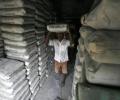
The March quarter (Q4) of the ongoing financial year (FY23) may see cement companies report better financial numbers as input costs ease, pricing action resumes, and cement demand remains firm. While companies have been cautiously optimistic about their outlook, analysts and sector experts remain bullish. In its latest report on the cement sector, brokerage IDBI Capital said that it expected earnings before interest, tax, depreciation, and amortisation (Ebitda) per tonne for cement companies to improve by Rs 200-300 sequentially in Q4.

During 2023, the Indian real estate sector - both housing and commercial - witnessed buoyancy fuelled by demand, supply, and absorption, and the sector is banking on the upcoming Budget to keep the momentum going. Mumbai-based Sattva Group wants the government to focus on the critical pillars for long-term growth. The company emphasised on the infrastructure boom with increased allocation, lower goods and services tax (GST) rates, incentives for affordable housing and single-window clearance to fast-track projects and support liquidity.
